
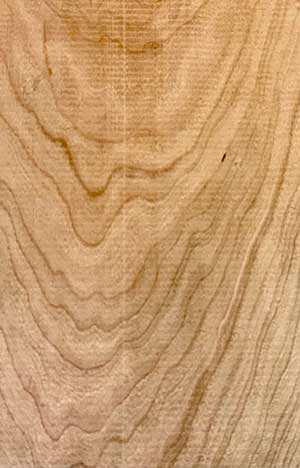

Visual and Physical Characteristics
-
Color Transformation: Newly cut cherry veneer typically has a light pinkish or creamy golden hue. Over a period of six months to several years, it undergoes a distinct “ripening” process, darkening significantly to a deep, lustrous reddish-brown patina when exposed to light and air.
-
Grain Patterns: Characterized by a fine, closed, and mostly straight grain, similar to maple but with more color variation.
-
Flat Cut (Plain Sliced): Features gentle “cathedral” arches and loops.
-
Quarter Cut: Produces a more disciplined, straight-lined, or “striped” effect.
-
-
Natural Markings: Often includes small, dark resin pockets known as gum spots or “pitch pockets,” as well as occasional pin knots, which add authentic organic character.
-
Texture: Fine-grained and dense, it finishes to a glass-like smoothness and high natural luster.

Common Applications
-
Modern Cabinetry: Especially popular for “slim shaker” or flat-panel kitchen cabinets that lean into the “rich wood tone” trend.
-
Fine Furniture: Used for high-end dining tables, executive desks, and bedroom sets where a consistent reddish-brown finish is desired.
-
Musical Instruments: Frequently applied to pianos, violins, and high-end speakers for its aesthetic elegance and tonal stability.
-
Interior Millwork: A standard for libraries, built-in shelving, and architectural wall panels in upscale residential and commercial spaces.

Key Advantages
-
Sustainable Warmth: Designers are using cherry veneer to meet the demand for authentic,warm-toned materials. Veneer maximizes wood usage, allowing one log to cover a significantly larger area than solid planks.
-
Stability: The cross-layered core prevents the warping or splitting often seen in solid
cherry, making it ideal for the large-format profiles and seamless slab-style cabinets. o
-
High-End Affordability: It provides a “luxury” aesthetic (sometimes called “wealthy
wood”) at a more approachable price point than solid cherry or walnut.