
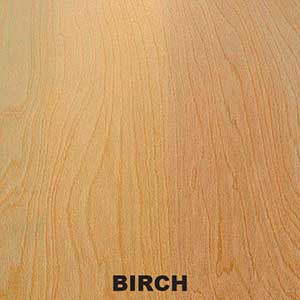

Visual Appearance and Grading
-
Cabinet-grade birch is selected for its clean face and consistent coloration.
-
Color Profile: It features creamy-white to pale yellow sapwood and light reddish-brown
heartwood. Unlike “common” birch, cabinet-grade material is often color-sorted to ensure a uniform “white” look for entire cabinet runs.
-
Grain and Texture: It has a fine, closed-pore structure similar to maple. While generally straight-grained, cabinet-grade birch may occasionally exhibit highly decorative “curly” or “wavy” figures that add visual depth.
-
Surface: Once sanded, it provides a glass-smooth surface without the deep “cathedral”
arches found in oak or ash.

Physical and Performance Characteristics
-
Hardness: With a Janka hardness of 1,260 lbf, it is nearly as hard as red oak (1,290 lbf). This makes it significantly more durable and dent-resistant than softer woods like poplar or alder.
-
Structural Integrity: Birch is exceptionally strong and heavy, offering excellent screw- holding capacity. It is less prone to “fuzzy” edges during machining than poplar.
-
Stability: Cabinet-grade birch is strictly kiln-dried to 6–8% moisture content. While very stable, it is slightly more prone to seasonal movement than maple, necessitating proper sealing.

Finishing Versatility
-
The “Paint Grade” Premium: Cabinet-grade birch is a top choice for professional painted cabinets. Its tight grain prevents “telegraphing,” ensuring a flat, modern finish that resists cracking at the joints.
-
Staining Capability: Birch takes stains more readily than maple. Because of its similar
grain, it is frequently used by manufacturers to mimic more expensive species like cherry
or mahogany.
-
Blotching Caution: Like many closed-grain woods, birch can be prone to uneven stain
absorption. Professionals typically use a pre-stain conditioner or a “toner” to achieve a uniform color.

Common Uses
-
In high-end cabinetry, the term “cabinet-grade birch” most frequently refers to Baltic Birch Plywood:
-
Multi-Ply Construction: This specific grade features more layers (plies) of birch veneer than standard plywood, with no internal voids.
-
Stability: It is the industry standard for drawer boxes and cabinet carcasses because it remains perfectly flat and possesses incredible structural strength.