
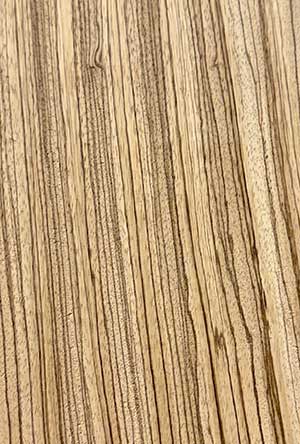
Zebrawood

Color Range
The heartwood features a light golden-yellow or creamy-tan base color with pronounced, narrow streaks of dark brown to near-black.

Grain
Quartersawn: Most commonly used for its straight, uniform "pinstripe" appearance. Flatsawn: Yields a more chaotic, wavy, or "flame" pattern.

Texture
The wood has a coarse, open-pore texture and a high natural luster.

Other Names
Other names here.

Typical Uses
Luxury Interiors: Popular for dashboard veneers in high-end cars and custom yacht cabinetry. Musical Instruments: Increasingly used for guitar bodies, drum shells, and ukuleles due to its resonance and striking visual impact. Sporting Goods: Historically used for skis and tool handles due to its high stiffness and toughness. Small Goods: A favorite for turning projects such as pens, bowls, and knife handles.
Weight
3.83
More info
lbs /Bd. Ft. | 6.98% heavier than red oak (3.58 /bd. ft.)
Hardness
2090
More info
Janka Rating | 62.02% harder than red oak (1290 psi)
Density
0.74
More info
Specific Gravity | 15.62% more dense than red oak (.64)
Strength, Stability, and Durability
Stability: It is difficult to season and prone to warping or surface checking during the drying process, though it becomes stable once properly kiln-dried.
Workability / Finishing
Tearout: Its interlocked grain makes it notoriously difficult to surface or plane without "tearout" (chipping). Razor-sharp tools or spiral-head planers are recommended. Odor: When worked, it emits a distinct and often unpleasant "musty" or "earthy" smell similar to wet hay or urine. Finishing: Due to large open pores, a transparent grain filler is often required to achieve a smooth, glass-like finish.