

Visual Appearance and Grading
-
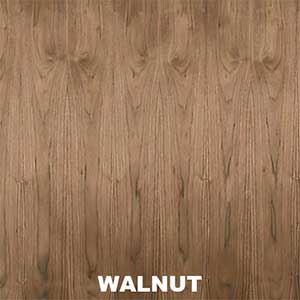
Color Profile: The heartwood is naturally a deep chocolate brown, often featuring purplish or dark gray undertones. Unlike common walnut, cabinet-grade material is often steamed to darken the creamy-white sapwood so it more closely matches the rich heartwood.
-
Grain Patterns: It features a mostly straight, fine grain but is highly prized for decorative figures such as curls, waves, or burls.
-
Aging Process: A unique trait of walnut is that it naturally lightens over time with UV exposure, shifting from a dark espresso to a warmer, golden brown.

Physical and Performance Characteristics
-
Hardness: With a Janka hardness of 1,010 lbf, it is softer than oak (1,290 lbf) but slightly harder than cherry (950–995 lbf). While it is moderately resistant to daily
wear, it can be prone to dents if subjected to heavy impact.
-
Stability: Cabinet-grade walnut is exceptionally dimensionally stable. It has low shrinkage rates, meaning it is less likely to warp, twist, or cup even in humid
environments.
-
Workability: It is considered one of the best domestic woods for machining; it sands to a “mirror-like” finish with minimal effort and glues and finishes beautifully.

Finishing Versatility
-
FAS (First and Seconds): This is the top grade for cabinets, providing the highest percentage of long, clear cuttings with minimal knots.
-
Reduced Defects: Cabinet-grade walnut has a much lower allowance for knots, sapwood on the face, and mineral streaks compared to “rustic” or “common” grades.
-
Select Grade: Often used for veneer doors, this grade features a more consistent color and reduced sapwood for a uniform, high-end look.

Common Uses
-
Shift Toward Warmth: Walnut is rapidly replacing pale white oak as the preferred wood finish, with 59% of designers reporting increased demand for its richer, darker tones.
-
Finish Preferences: High-gloss lacquers have declined; the standard “look” for walnut is a
matte or raw finish that lets the natural texture of the wood breathe.
-
Island Accents: It is frequently used for “statement islands” paired with warm neutral
perimeter cabinets (such as mushroom or taupe) for a sophisticated, two-tone effect.